Algorithms
How the Facebook Algorithm Really Works in 2026 (And What's Just Guesswork)
"Facebook hides your posts unless you pay." Every business owner whose Page reach has collapsed has heard it. The claim is half true and half myth, and the difference decides whether Facebook is still worth your effort.
The good news is that Meta explains part of it directly. Its Transparency Center describes the steps that rank the feed and which content the platform deliberately holds back. It's the best source available, but it's also Meta's own account of its own product, not an outside auditor's report.
Let's take three things one at a time: what Meta itself claims, what outside data suggests, and what's just social-media folklore.
What Meta says about itself
These aren't tip-list guesses. They're Meta's own documented positions, published in its Transparency Center. That makes them far better than a guess. It doesn't make them verified, because this is what Meta says it does.
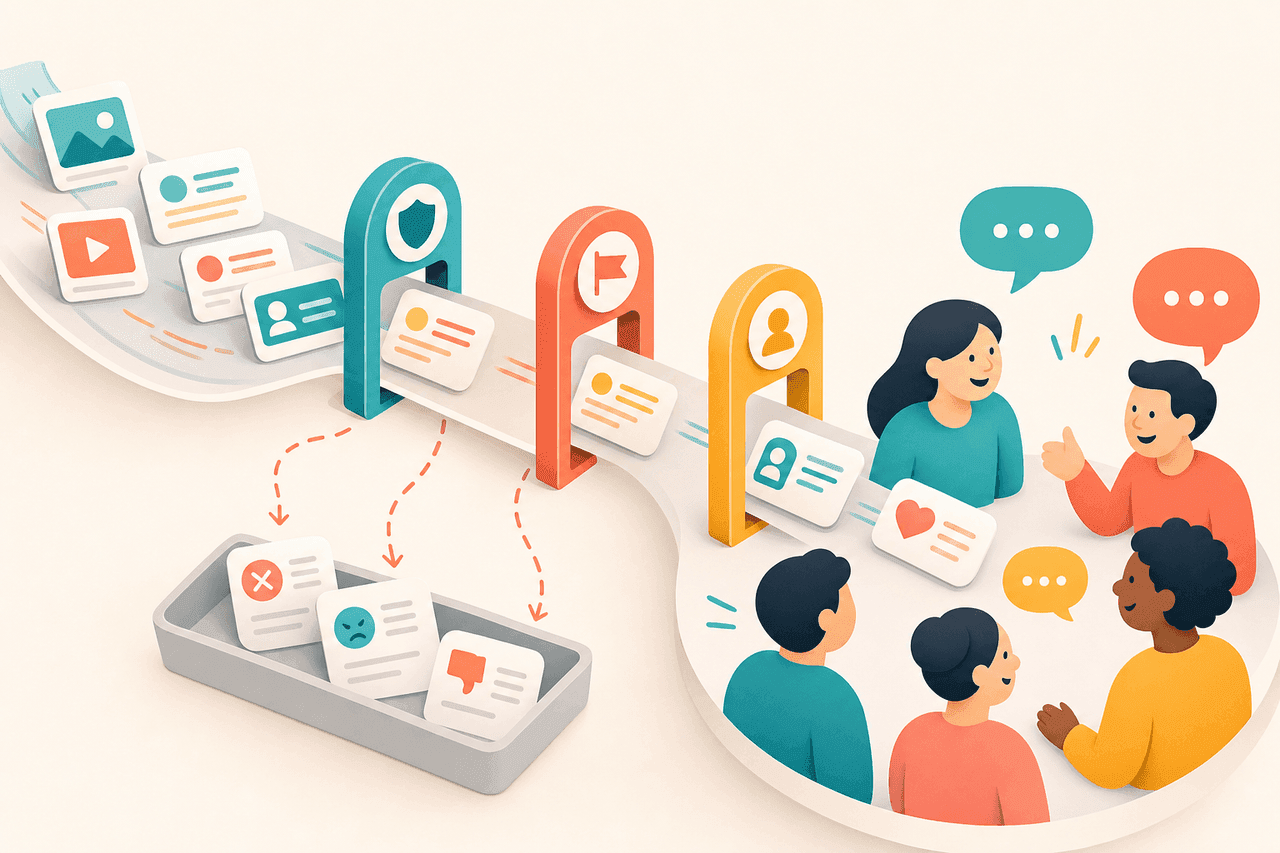
The feed is ranked by prediction, not chronology. Every time you open Facebook, four steps run behind the scenes: available content (inventory), signals, predictions, and a relevance score. Meta runs over a hundred prediction models in parallel. They predict how likely you are to comment, share, watch a video to completion, click, or spend time with a post. Some signals are explicit (like, comment, share), some implicit (how long you look). The post with the highest prediction for you specifically rises in the feed.
Interactions between people come before Pages. Meta has said it prioritizes meaningful interactions — posts that spark conversation, and especially content from friends and family over content from businesses and Pages. This is a big reason a business Page's organic reach is small: the Page competes for the same space as people's own posts, and the algorithm favors the latter.
Meta deliberately holds back certain content. Its content distribution guidelines state plainly what gets reduced reach:
- Engagement bait. Posts that ask people to like, comment, or share even when the content isn't genuinely meaningful to them. Meta says it directly: reach on these posts drops, and Pages that repeatedly use the tactic see an even bigger fall.
- Clickbait. Headlines that create misleading expectations ("You'll never guess what happened…"), withhold information, or shout in all caps.
- Repurposed content. Meta reduces content that is principally reused from other sources rather than made by you.
Original content is rewarded. Since 2024–25 Meta has boosted content people make themselves and demoted aggregators that repost other people's clips. Content counts as original when the creator or Page owner filmed or produced it themselves.
You have controls. "Show more / show less" and "Why am I seeing this?" both explain and steer what the feed surfaces. These are real signals, not decoration.
Why this matters
Everything above comes from Meta itself. It won't be outdated next month, because it describes what the algorithm is trying to do, not this week's specific tuning. Meta is still describing its own product here, and the description doubles as communications.
What Meta doesn't tell you
A platform's own account is always the tidied-up version. It gives you the principles, never the weights, and it rarely tells you what actually happens in the feed.
A stated policy and what actually ships are different things. Meta says it prioritizes content from friends and family. At the same time, its own AI blog states that more than 20% of the Facebook and Instagram feed is AI-recommended content from accounts you don't follow. Both claims are Meta's own. They pull in different directions, and the second one explains what you actually see in the feed better than the first.
A policy is not a measurement. Meta says it reduces the reach of engagement bait. That's a statement about what the platform is trying to do, not evidence that it succeeds. No outsider can check how much reach any given post actually lost.
The weights are a trade secret. Over a hundred prediction models get a mention; how much each prediction counts toward the final score does not. That's why no exact multiplier you see in a tip list can have come from Meta.
What the data suggests
The next tier is weaker than official sources but stronger than a guess. Outside measurements show how the numbers look in practice.
Social Insider's measurement puts a business Page post at an average of 1.2% of followers (data from May 2024 to May 2025). In 2012 the figure was around 16%, and that one is Facebook's own disclosure from the time. Engagement across 25 million posts sits at 0.15% and didn't move at all year over year. Views on Page posts fell 17%.
Read the format data carefully. In that same set the best engagement didn't come from video but from plain text updates (0.20%); Reels and albums landed at 0.18%, and link posts collapsed to 0.05%. The case for Reels is distribution instead: Meta said in its October 2025 update that it surfaces 50% more same-day Reels. The distinction is worth making. Reels reach new people, but "only video works" doesn't survive the current data. Link posts are the one format worth avoiding outright.
What's just guesswork
This is where many tip lists go off the rails.
"Facebook hides your posts to force you to pay." Reach is small, that's true. But it isn't a mechanical paywall — it's prediction-based ranking where Page content loses to people's own content. Ads buy visibility, but organic reach isn't zeroed out. It's earned.
"There's one magic posting time that guarantees reach." There isn't. Timing is a window, not a single minute. Publish when your audience is around, and stop chasing one clock reading.
"Hashtags boost reach." On Facebook the effect is small, unlike on Instagram. A few tags won't hurt, but they aren't the lever that makes a post fly.
"Ask for likes and shares, it grows visibility." The opposite. Meta calls this engagement bait and reduces its reach. Asking "does anyone else agree?" hurts a post rather than helping it.
What the algorithm actually rewards
Set the guesswork aside, and Meta's own positions plus the outside data point to a few durable principles. They'll still hold next year, because they follow from how the model is built, not from this month's adjustment.
- Genuine interaction beats passive reach. The model predicts comments and shares. A post that gets people actually talking beats one that collects quick glances.
- Originality beats recycling. Meta rewards content you made yourself and demotes what you borrowed. Your own photo and your own video are an advantage.
- Earn it, don't beg. Engagement bait is penalized. A genuine hook isn't.
- Format follows attention. Reels and short video get distribution because they hold the viewer, and the model predicts watch time.
How a small business does this without a marketing team
Knowing this isn't the bottleneck for a small business. Applying it week after week, with no dedicated person, is.
- Publish content you made yourself. Your own photo and your own short video do well; a borrowed meme doesn't.
- Spark real conversation instead of asking for likes. Ask something your audience actually has something to say about.
- Use short video when you want to reach new people. Plain text works for existing followers too. Link posts work for neither.
- Keep a steady cadence. It matters more than the perfect clock time.
The hard one is that fourth point, steady cadence. Anyone can make one good post. Keeping fresh, original content on a Facebook Page week after week is what usually collapses under a lack of time while you run everything else. A steady cadence doesn't mean posting daily, whatever the advice says. We covered that separately: how often you should post on social media.
Steadybeat handles exactly that: you make and schedule content in one go and publish the same thing to Facebook, Instagram, and elsewhere at once. Knowing the algorithm only helps once content actually appears on a regular basis.
Keep the cadence without a marketing team
Write, schedule, and publish to every channel from one place. Try Steadybeat
Sources
Verified in August 2026. The algorithm changes, so it's worth checking the platform's own points against the original source.
Platform sources (Meta describing its own product):
- Meta Transparency Center: Our Approach to Facebook Feed Ranking
- Meta Transparency Center: Engagement Bait
- Meta Newsroom: Sharing Our Content Distribution Guidelines
- Meta Newsroom: Finding and Sharing Reels on Facebook Just Got Easier and More Fun (the +50% same-day Reels figure)
- Meta AI: The AI behind unconnected content recommendations (over 20% of the feed from accounts you don't follow)
Outside measurements (not confirmed by Meta):
- Social Insider, Social media reach statistics. 1.2% reach, data from May 2024 to May 2025.
- Social Insider, Facebook engagement benchmarks. 25M posts, 130,683 Pages, January 2024 to December 2025.
Read also
How the Instagram Algorithm Really Works in 2026 (And What's Just Guesswork)
Instagram head Adam Mosseri explains which signals rank content. We separated three things: what the platform itself claims, what outside data suggests, and what's pure guesswork.
How the TikTok Algorithm Really Works in 2026 (And What's Just Guesswork)
TikTok's own newsroom explains how the For You feed recommends videos. We separated three things: what the platform itself claims, what outside data suggests, and what's pure guesswork.
How the LinkedIn Algorithm Really Works in 2026 (And What's Just Guesswork)
LinkedIn's own engineering blog explains how its feed ranks content. We separated four things: what the platform has documented, what it doesn't say, what the data suggests, and what's pure guesswork.